Start here - what is a transformer?
This is Lesson 1 of XFMR Training, exactly as it appears inside Lineman's Reference - XFMR Lab. Free, no signup. Read it through, tap the purple checks to quiz yourself, and when you hit the end: the wiring happens in the app.
Part 1 - What is a transformer?
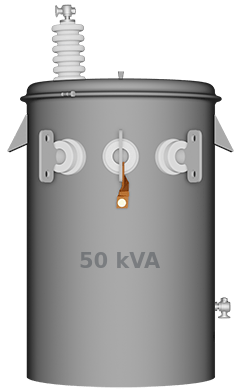
A transformer is a piece of electrical equipment that takes one specific voltage and turns it into another. In distribution linework, that almost always means stepping the high voltage on the utility line down to the lower voltage a home or business can use. Out in the field, you'll almost always hear a transformer called a 'pot.' They're the same thing, and we'll use both words from here on. By the end of this first lesson, you'll wire this transformer up yourself.
This app is a simulation. It won't capture every wrinkle you'll hit in the field, but it's a safe environment to learn what each connection does before you do it for real.
Part 2 - The external parts
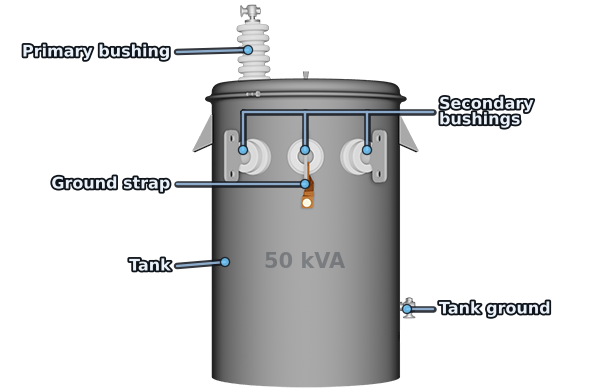
Let's go over what the individual parts are called, then we can get into their function.
The terminals where energized wires land, or connect, are called bushings. Bushings are typically composed of a porcelain shell that separates energized metal components from grounded ones.
- The single bushing up top is the primary bushing, where the high voltage connects.
- The three across the face are the secondary bushings, where the customer's service wires connect.
- The steel body is called the tank, and the Tank Ground bonds it to the system neutral or other ground reference, preventing the tank from becoming energized.
- The ground strap is a removable strap that is used to bond the tank to an additional ground reference.
Part 3 - The primary side
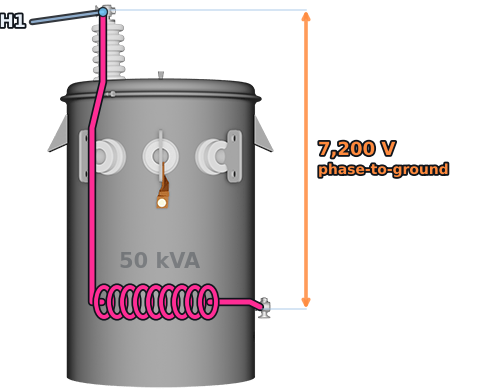
The primary side is fed straight from the power line.
You'll also hear the line side called the "feed": "fed from," "feeding," same idea. It's field shorthand for the source: where the power comes from.
This pot has a single primary bushing, H1. Some transformers have more than one primary bushing, and they are labeled H1, H2, etc., left to right.
On a 7,200/12,470 V system, a primary meter would read ~7.2 kV from H1 to ground when energized. The number of primary bushings, and why this one is connected internally to the tank ground, will be covered soon.
Part 4 - The secondary side
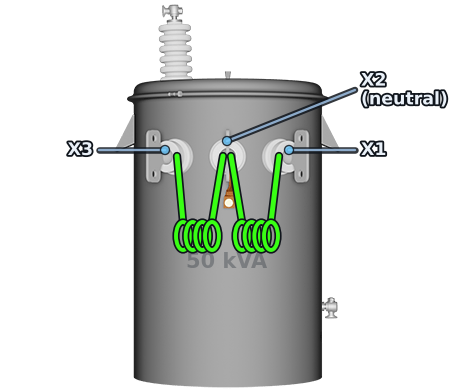
The secondary side feeds the customer. Typically there are three bushings: X1, X2, and X3.
X1 and X3 are both hot legs; X2 in the middle is the neutral. A voltmeter reads 120 volts from either hot to the neutral (X1-X2 or X2-X3), and 240 volts from hot to hot (X1-X3). That's the standard 120/240 service.
We'll cover the visual order and positioning of the secondary bushings, and why it's grounded at X2, later on.
Part 5 - The two coils inside
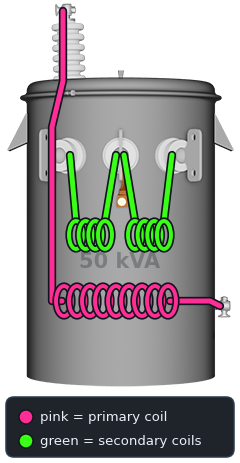
Inside a transformer are 2 tightly-wound coils, rated for different voltages:
The Primary Coil (pink) - the side using "primary" voltage from the power line.
The Secondary Coils (green) - the two coils tied to the "secondary" bushings on the face that handle usable "secondary" voltage.
Part 6 - The turns ratio
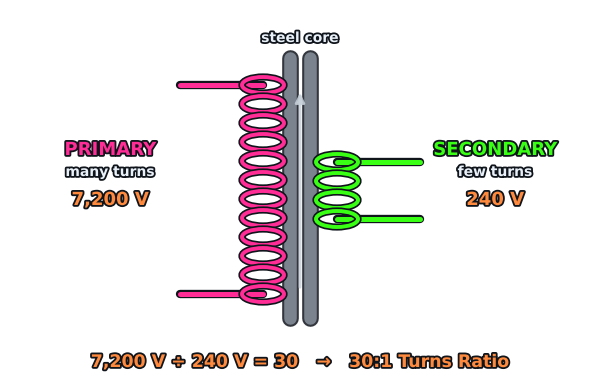
So how does a transformer actually change voltage? Simply put: the energized primary coil and the power line's alternating current build a constantly-moving magnetic field in the steel core, and that moving field induces, or "pushes," voltage onto the secondary coil.
The two coils don't actually touch. The amount of voltage induced is set by the number of windings, or "turns", in each coil. The ratio of windings between the primary and secondary coils is called the transformer's Turns Ratio. To find a transformer's turns ratio, divide its primary voltage rating by its FULL secondary voltage rating: 7,200 ÷ 240 = 30 → 30:1 Turns Ratio.
IMPORTANT: Transformers step voltage in both directions! If you supply EITHER coil with voltage it WILL be stepped. If you supply this transformer's secondary coil with 240 V you WILL get 7,200 V at H1.
Turns ratio = voltage ratio and that's the basics of how transformers work.
A transformer works in BOTH directions. The same turns ratio that turns 7,200 V into 240 V can also turn 240 V into 7,200 V. Backfeeding the secondary on a "de-energized" pot will cause the primary to become energized at full potential.
Part 7 - The tank ground serves as your H2
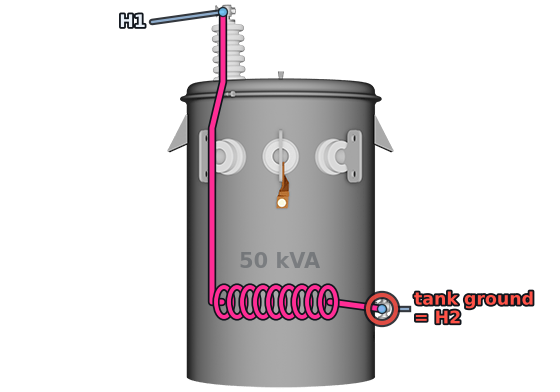
On a single-bushing (GRD-Y) transformer there's no second primary bushing. The primary coil's far end runs to the tank ground instead, so the tank ground serves the same purpose as an H2.
That puts the tank ground right in the primary circuit. Bonded to the system neutral, it normally reads near-zero volts.
BUT IF THAT GROUND IS MISSING OR BROKEN WHILE ENERGIZED, the tank can rise to primary voltage and energize the whole steel tank. Treat it as primary-side. It's one of the most important, and most deadly, connections on the transformer.
No tank ground on this transformer means that the tank can become energized at primary voltage. Grounds - first on, last off.
Part 8 - The X2 ground reference
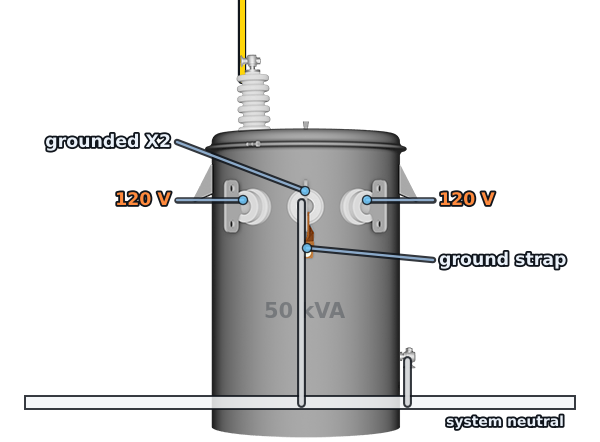
On most single-pot configs, you will see the X2 being used as the grounded secondary bushing. The X2 is the center point between the two secondary coils, and when grounded, a balanced 120 volts is output on both X3 and X1.
Which secondary bushing is grounded directly affects the output voltage on the other two bushings.
Always connect your ground strap to the grounded bushing. The ground strap acts as a backup ground reference in conjunction with the tank ground.
Part 9 - Polarity
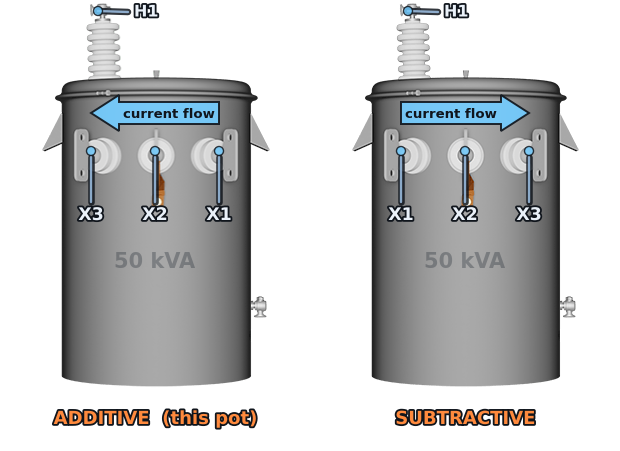
Part 4 from earlier left a loose end and it's important: the left-to-right order of the secondary bushings. That order is set by the transformer's polarity. Because of how the coils are wound, the secondary lines up with the primary in one of two ways, additive or subtractive, and the nameplate tells you which.
Polarity doesn't change any voltage. It flips the bushing order and, in turn, it flips current flow.
Polarity isn't random. It's standardized in transformer manufacturing, so every pot follows the same layout: additive runs X3-X2-X1 left to right; subtractive runs X1-X2-X3.
THE POLARITY RULE: a transformer is ADDITIVE only when its primary rating is 8,660 V or less AND its size is 200 kVA or less. Exceed EITHER one and it's SUBTRACTIVE.
Our 50 kVA pot rated 7,200 V is additive, but that same pot rated 14,400 V is subtractive. This is why X3 has sat on the left in every graphic so far.
Part 10 - Wire it
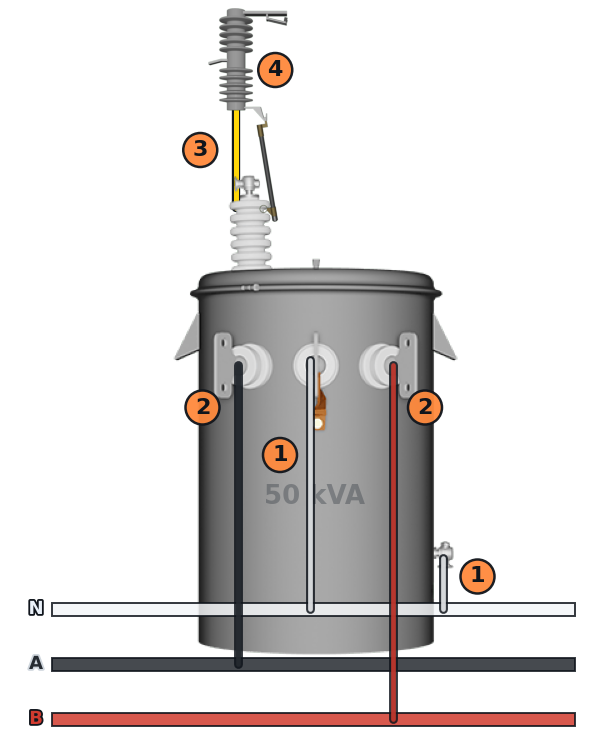
You've got every piece now. Time to put them together. Burn this rule in before you touch anything:
GROUND CONNECTIONS ARE FIRST ON AND LAST OFF.
1. Grounds first: wire the tank ground, X2's ground strap, and X2's system neutral jumper before anything else gets connected.
2. Secondary next: connect the hot legs to opposite secondary phases.
3. Primary: H1 gets connected once everything else is buttoned up.
4. Energize Last: close the cutout's fuse barrel (the cutout is the fused switch up on the pole). Nothing is hot until that barrel seats. Then anything connected to the bottom of the cutout becomes energized.
Wrecking a pot out runs the same process backward: open the cutout first, and the grounds come off last.
✅ What you should know:
- A transformer changes one voltage to another. This pot steps 7,200 V down to 120/240
- H1 is the primary; X1/X2/X3 are the secondary, landed by the X markings (polarity)
- The tank ground is the primary coil's other end (H2). Treat it as primary-side
- X2 is the grounded center point of the secondary coils. That's what makes two balanced 120 V legs
- Turns ratio = voltage ratio (7,200 ÷ 240 = 30:1), and it steps BOTH directions
- GROUNDS ARE FIRST ON AND LAST OFF
▶ Now wire it.
You just did the reading. In the app, this same transformer is sitting in a lab waiting for you: ground the tank, wire up the secondary, wire the topside, close the fuse and watch the voltages come to life. Then keep going. Lesson 2 in the app picks up right where this one left off.


XFMR Lab is $19.99, one time. All lessons, 16 labs, the Sandbox, and Death Traps included. No subscription.
- 2Dual H Bushings - the two wirings & the nameplate🔒 In the app
- 3The tap changer - one pot, multiple system voltages🔒 In the app
- 4Three-Phase: The 3 phases and how they're related🔒 In the app
- 5Bank Identification - delta or wye, open or closed🔒 In the app
- 6Your first bank - Delta-Wye Closed (120/208)🔒 In the app
- +More lessons on the way (4 more in the works right now)Soon