Why the wild leg reads 208V
You know the wild leg. The high leg, the hot leg, the stinger. And you know it reads 208 volts. This is the WHY: the geometry behind that number, and why the ground reference decides which corner the wild leg lands on.
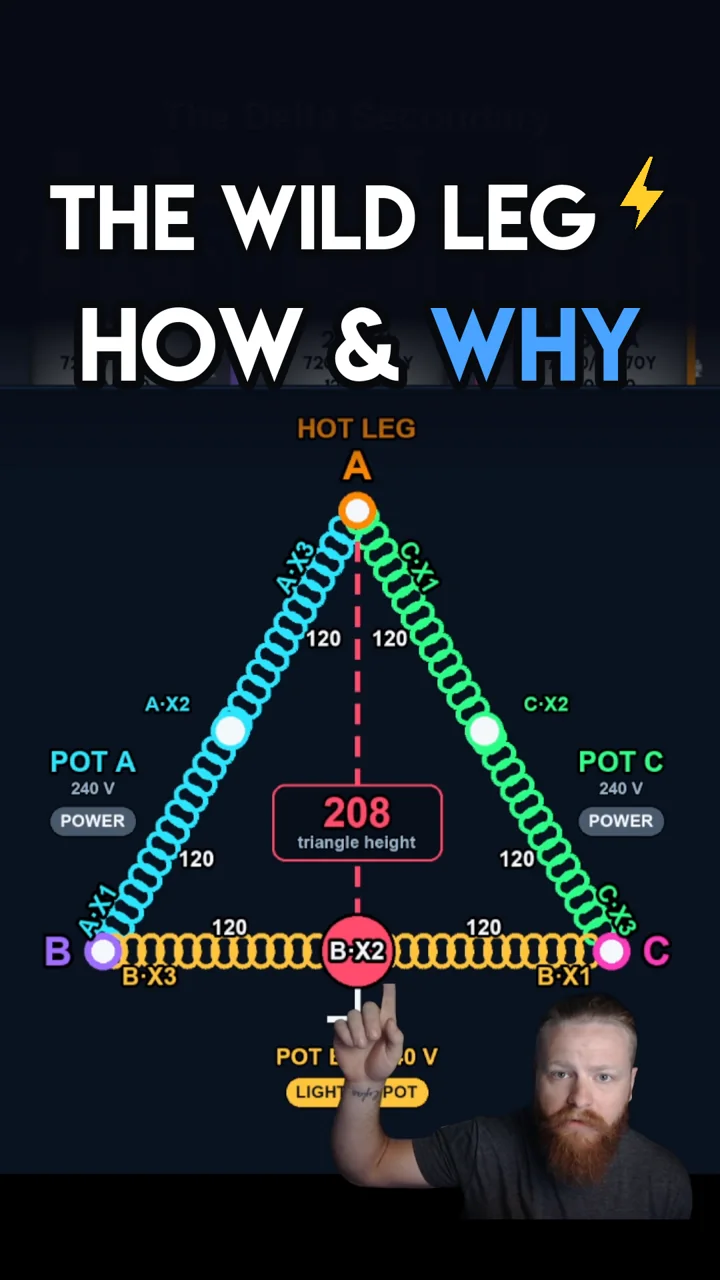
The two-minute breakdown. More on the channel ↗
The closed delta secondary
Forget the primary for a second and look at the secondary. A closed delta secondary is three pots wired corner to corner into a triangle. Each corner of that triangle is just the wiring between two transformers.
Each pot has two secondary coils, and each coil is rated for 120 volts. Put the two in series and you get a 240 volt rating across the pot, with the center tap (the X2) sitting right in the middle. So every side of the triangle is 240 volts.
The ground reference makes the wild leg
Where you put the ground reference decides where the wild leg ends up. When you ground an X2, you give the two coils attached to it a balanced 120 volts to ground. That pot becomes your lighting pot, and it carries the secondary neutral reference.
The wild leg is the corner on the triangle directly opposite the grounded reference. It is the one leg that is not sitting at a tidy 120.
The wild leg voltage is the triangle's height
Here is the trick that makes it click. On the triangle, the distance between any two corners is the voltage between them, and every side is 240.
The wild leg voltage is the distance from the ground reference straight up to the opposite corner. That distance is the height of the triangle. Not the length of a side, the height. That is the whole reason it is not 240.
The math: 1.73 × 120 = 208
The height of an equilateral triangle is the square root of three, divided by two, times the length of one side. The side is 240.
That is your 208 on the wild leg. Same number every time, because the geometry never changes.
Why it matters in the field
Whatever pot you ground becomes your lighting pot. It carries the lighting load and the bank's secondary neutral reference on top of its share of the three-phase load. That is why the lighting pot is usually the bigger KVA rating: it is doing more. The other two are the power pots, and they carry the three-phase load.
Ground a different X2 and the wild leg jumps to the corner across from that one. So when you swap a delta secondary out, that wild leg has to land back on the same corner it was on.
Flop where the wild leg lands on the customer's service and you can ruin all kinds of electrical equipment, or start a fire. On a swap, the wild leg lands on the same corner, every time.
✅ The short version
- A closed delta secondary is three pots in a triangle, 240 volts per side.
- Ground an X2 and that pot becomes the lighting pot and neutral reference.
- The wild leg is the opposite corner. Its voltage is the triangle's height.
- Height = √3/2 × 240 = 1.73 × 120 = 208 volts.
- On a swap, the wild leg lands back on the same corner. Flop it and you burn stuff up.
▶ Build it and break it.
You just read the why. In XFMR Lab you can wire this delta secondary yourself, move the ground reference, and watch the wild leg jump corners in real time. Build it, break it, and see the voltages come to life.

XFMR Lab is $19.99, one time. All lessons, 16 labs, the Sandbox, and Death Traps included. No subscription.