The corner-grounded delta
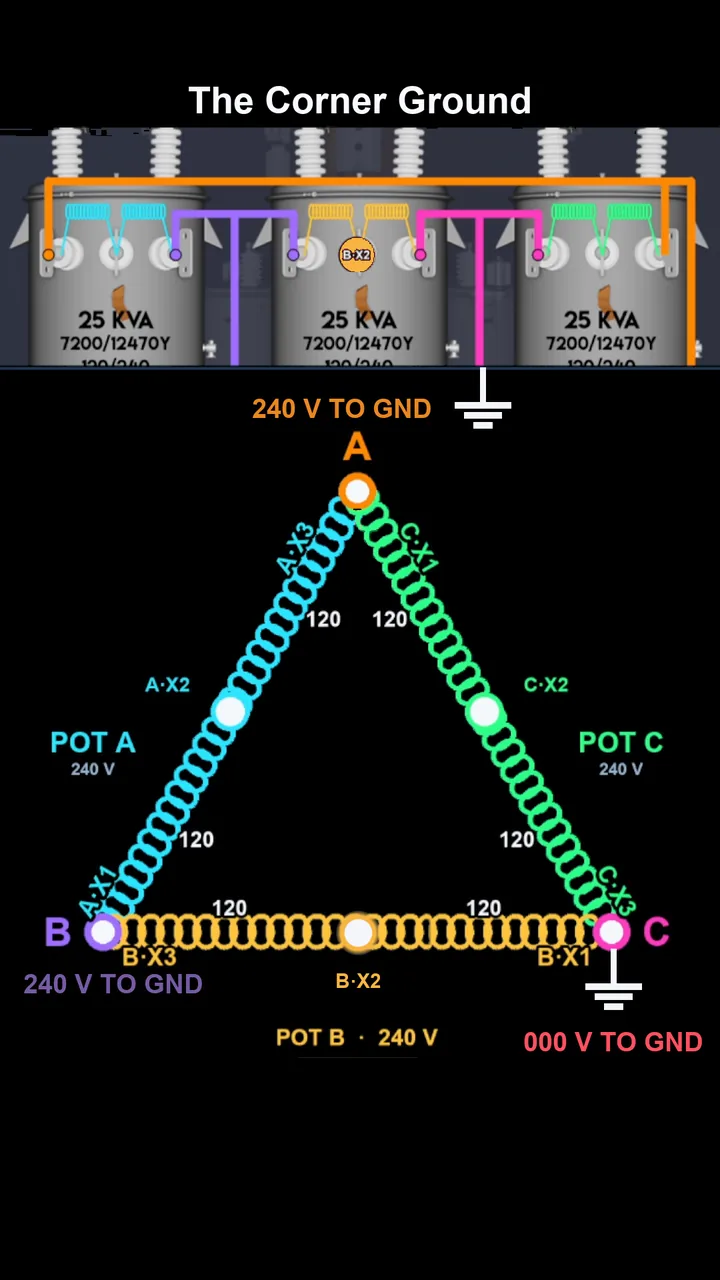
One phase reads zero volts to ground, and every other measurement reads the transformer's full secondary rating: 240 for 120/240 pots, or 480 for 240/480 pots. We're covering the 240 variant here, but the math is the same for both.
The full breakdown. More on the channel ↗
Quick recap
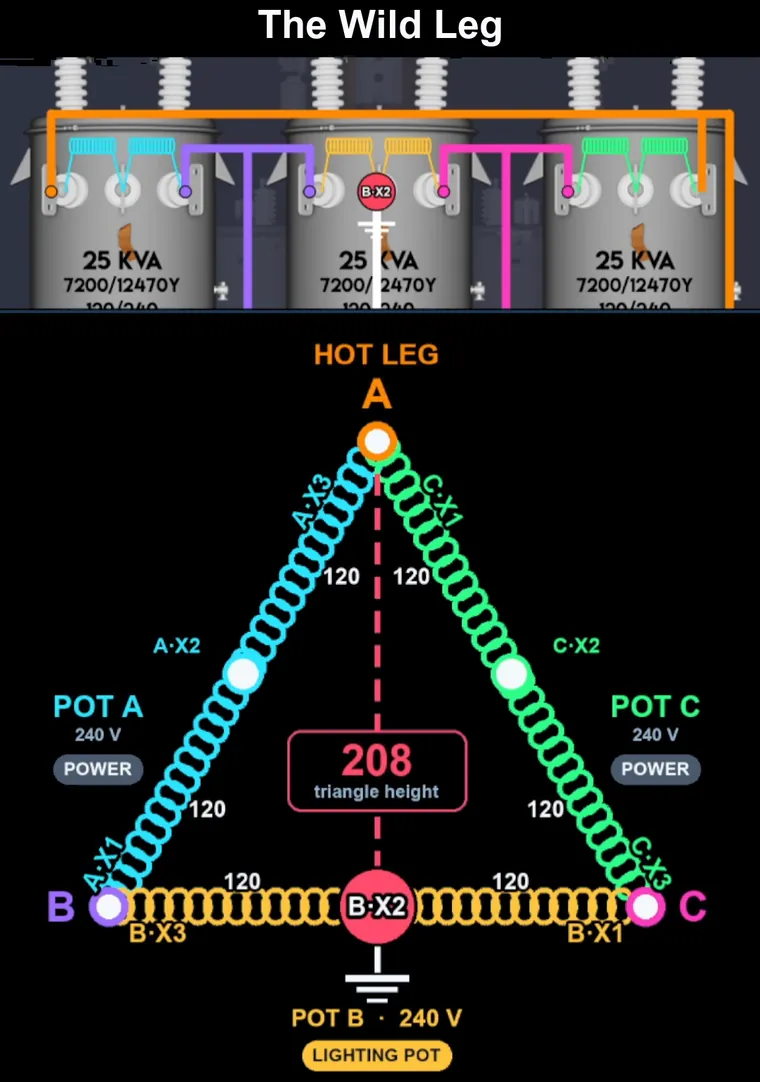
In the wild leg video we grounded the X2 of a closed delta secondary bank and went through the math behind its voltages.
Today we've got the same delta bank and the same vector graphics. We're just going to move the ground reference.
Connect one corner straight to ground
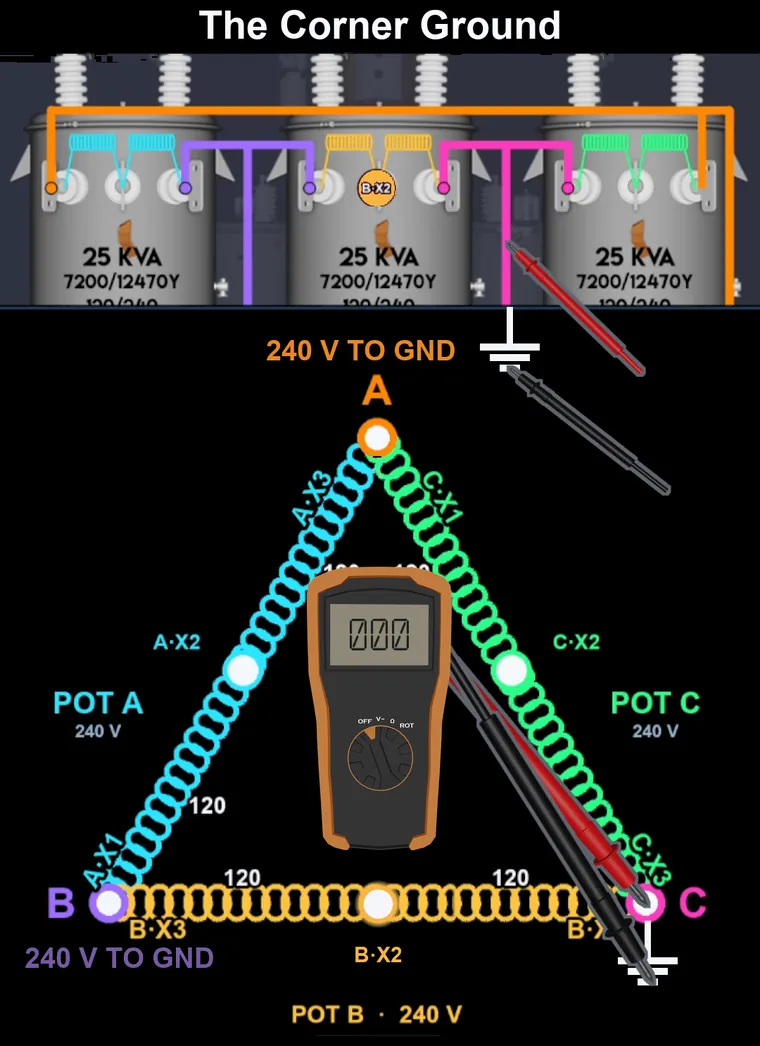
Connect one corner of this delta straight to ground, and that corner reads zero volts phase to ground, because it is now also the ground.
That phase is now grounded, and it is now the singular neutral reference on this bank's secondary.
There can only be one ground reference on a delta secondary. If you ground a second spot, you'll cause a fault.
So why does every leg read a full 240 back to that ground?
The phase-to-ground voltage is all about your phase's distance from your neutral reference, and that reference is now sitting on a corner of the delta.
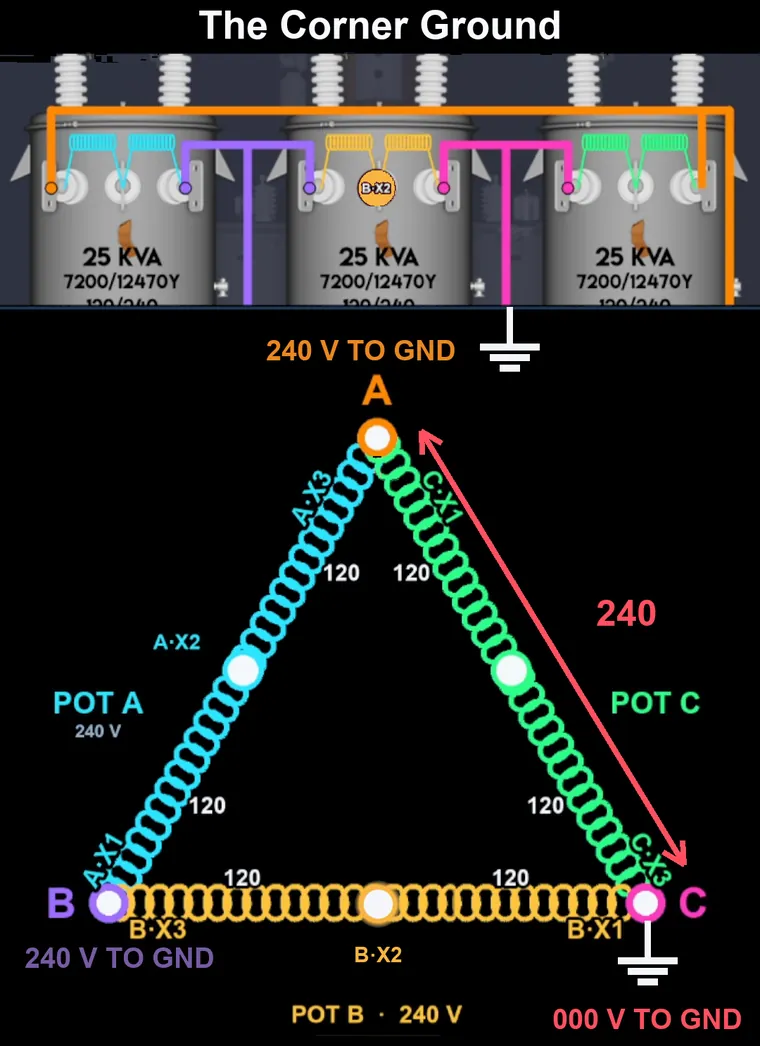
Every side of this triangle is one full transformer, with the secondary coils both in series. So from any other corner, the distance back to the grounded corner is one full pot: 240 on a 120/240 bank, 480 on a 240/480.
Phase to ground and phase to phase read the same
Phase to ground and phase to phase on this bank have the exact same readings, because your ground and a phase are now the same point. You're measuring the same distance between both types of readings.
240V corner-grounded (corner C grounded)
| Phase to ground | Phase to phase |
|---|---|
| A to grd 240 V | A to B 240 V |
| B to grd 240 V | B to C 240 V |
| C to grd 000 V | A to C 240 V |
480V corner-grounded (corner C grounded)
| Phase to ground | Phase to phase |
|---|---|
| A to grd 480 V | A to B 480 V |
| B to grd 480 V | B to C 480 V |
| C to grd 000 V | A to C 480 V |
240 on a 120/240 bank, 480 on a 240/480. One full pot away, every time.
Think about what your leads are touching
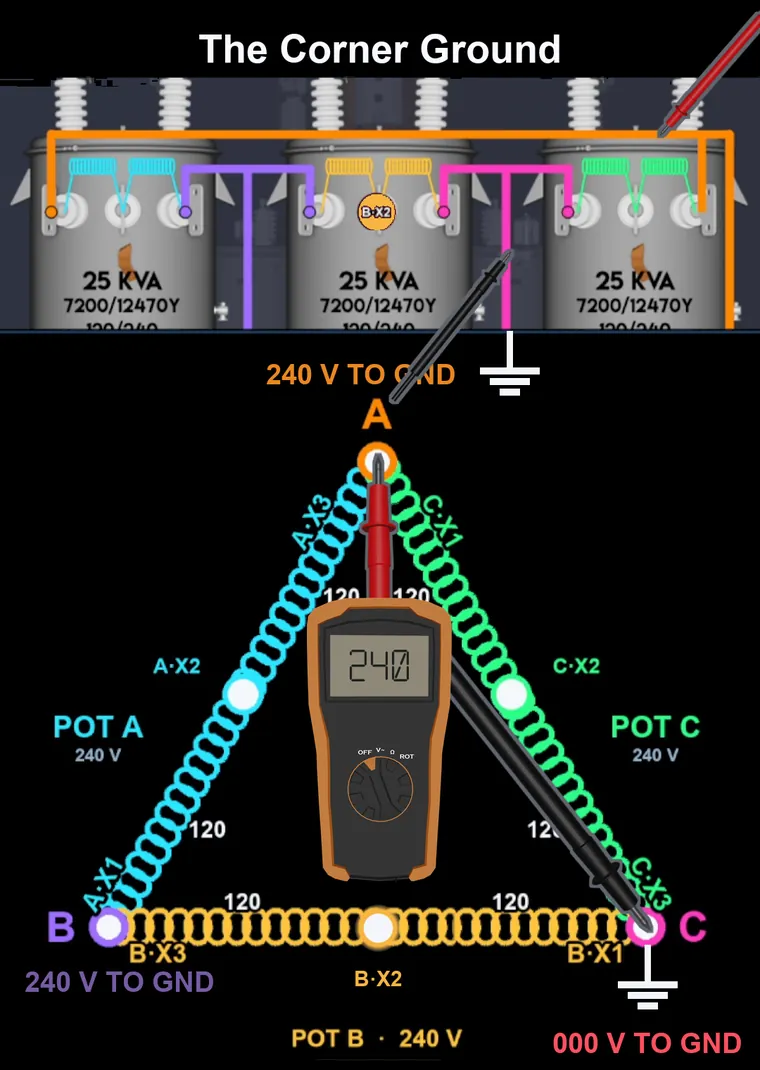
When I say you're measuring the distance between two points, think of those two points as what your voltmeter leads are actually touching.
Land one lead on a corner and the other on the grounded corner, and you're reading straight across the full secondary rating of one pot.
So why do we have this weird bank? Where does it come from?
Go back 70 or 80 years and ungrounded delta secondaries were everywhere. Three-wire, three-phase services at 240 or 480, with no neutral in the secondary at all.
Industrial plants loved them, because the first ground fault didn't trip a breaker or blow a fuse. The shop kept running.
But a floating secondary has a downside. Without a ground reference, a fault can drive voltages way past the transformer's rating and start eating the transformer's insulation.
Grounding fixes that. But on a three-wire delta secondary there's no fourth wire to turn into the neutral, so a corner was the only spot they could ground. Connecting the corner to ground stabilized the voltages for the secondary just by installing a single jumper. No new transformer, no new wire.
That's how she came to be. They don't get built new anymore as far as I know, but plenty of corner-grounded banks are still out there humming, and now you know the how and why of the voltages, and not just the wiring.
The grounded corner is a current-carrying conductor, and it can read above zero volts if the ground path is carrying current, or if the ground connection is not good enough or goes bad.
This is why we say that even though on paper it reads zero volts, it still needs to be treated as an energized phase.
✅ The short version
- Same delta bank as the wild leg video. The only thing that moves is the ground reference.
- Connect a corner straight to ground and that corner reads zero, because it is now also the ground, and it is now the bank's singular neutral reference.
- Only one ground reference per delta secondary. Ground a second spot and you'll cause a fault.
- Phase to ground is your phase's distance from that reference, and every side of the triangle is one full pot in series: 240 on a 120/240 bank, 480 on a 240/480.
- Phase to ground and phase to phase read the same, because your ground and a phase are now the same point.
- The grounded corner is a current-carrying conductor. It reads zero on paper, but it gets treated as an energized phase.
▶ Build it and break it.
You just read the why. You can wire up both the 120/240 and the 240/480 corner ground banks yourself in XFMR Lab, move the ground reference, and watch the phase-to-ground readings follow it in real time. Build it, break it, and see the voltages come to life.

XFMR Lab is $19.99, one time. All lessons, 16 labs, the Sandbox, and Death Traps included. No subscription.