The open bank: two pots, full three-phase
Two pots on the pole, and a full three-phase secondary coming off them. Nothing is missing and nothing is broken. That is an open bank, and once you know what you're looking at, you'll see them everywhere.
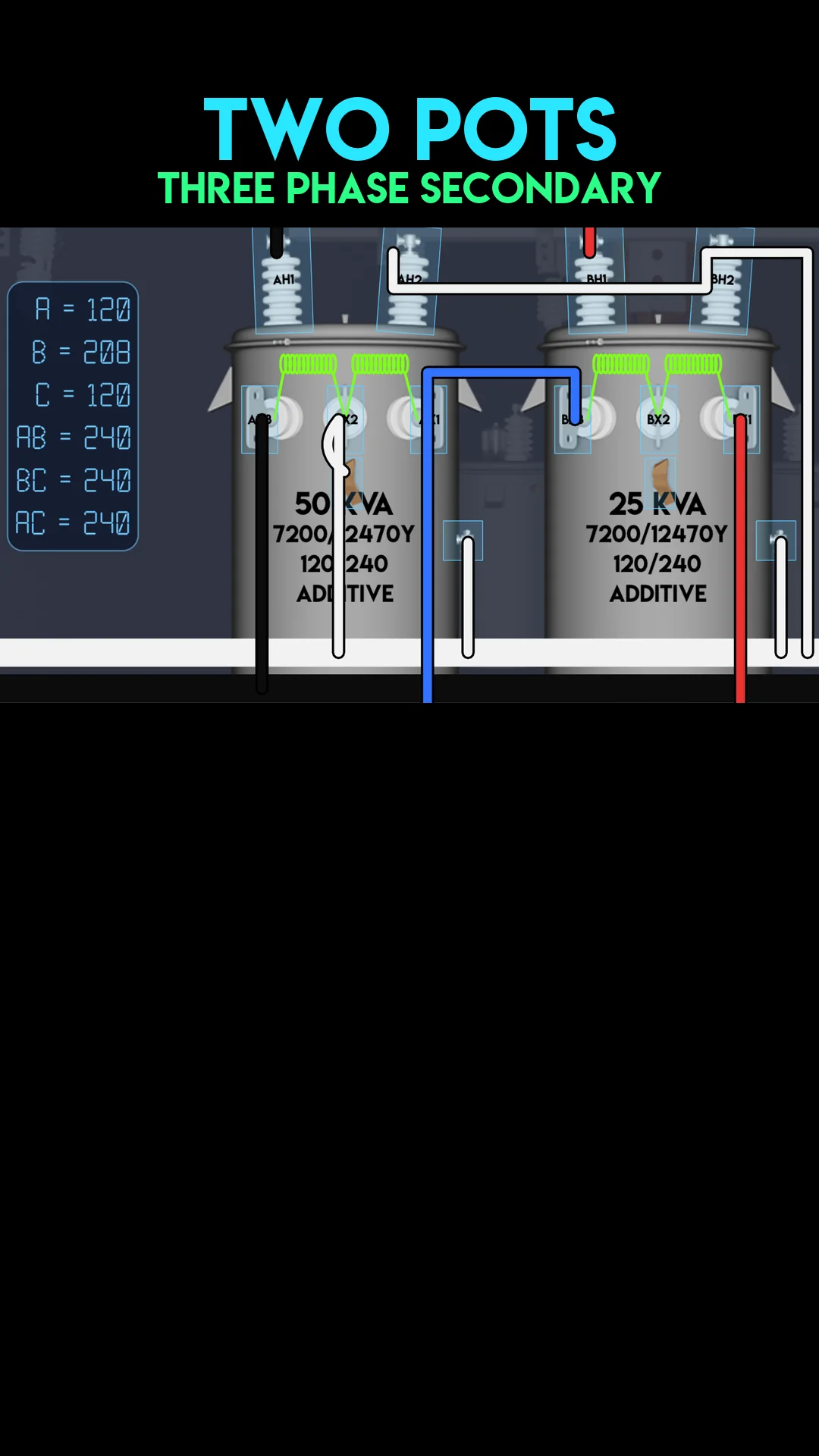
The full breakdown. More on the channel ↗
There are only two ways to build a normal open bank
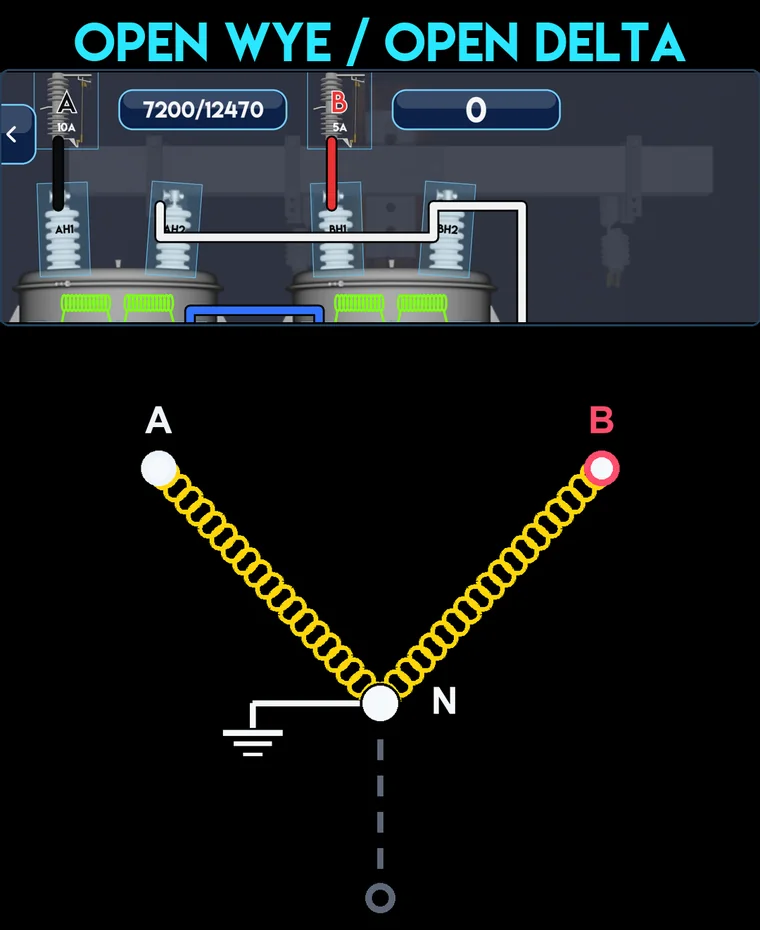
Open wye / open delta, and open delta / open delta. You'll likely run into the open wye variant more often.
On the open wye / open delta, both pots' H1 bushings go to their own phase, and both H2s tie to the primary neutral. Two phases and a neutral is all you need, and that is the whole reason this bank exists: the utility only had two phases on site and didn't want to build a third one in.
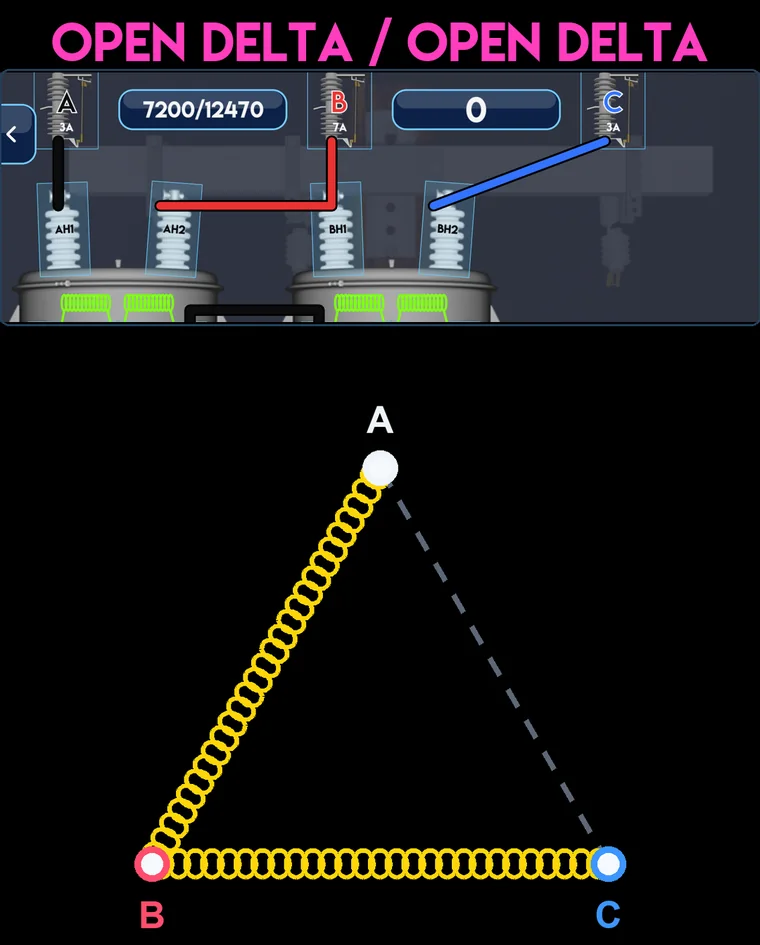
The other two-pot bank is the open delta / open delta. Two pots again, but now each pot connects phase to phase on the primary, and the two transformers are each supplied a different pair of phases. So the open delta needs all three phases up top: two cans on the pole, three phases feeding them.
This bank is much less likely, because if you have three phases present, the main reason for building an open bank disappears.
So how do two pots make three phases?
It's the same answer for both banks. Both primaries are fed off voltages that are already 120 degrees apart: two legs of the wye, or two different pairs of the delta.
Each pot copies its own primary's angle onto its secondary, so the two banked secondaries come out 120 degrees apart too. You only need two primary voltages offset by 120 degrees to make a three-phase secondary.
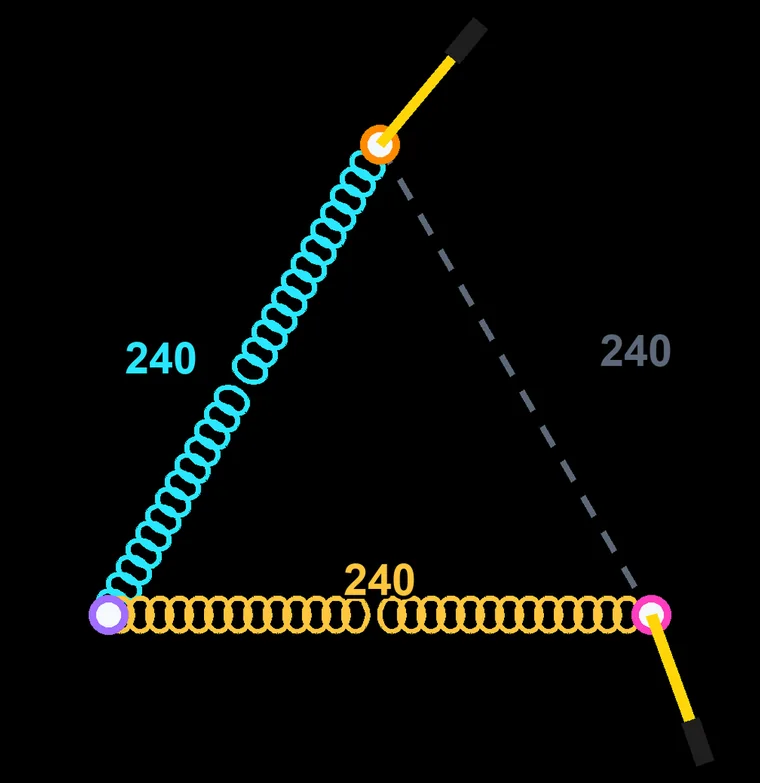
Put your leads across the open side and you don't read zero. You read the same 240 you'd read across either pot, sitting 120 degrees off both of them. That third leg is real. It just doesn't have another transformer's core behind it.
Erase one side of the delta
A two-pot bank, an open bank, is always a delta secondary. There are some oddball exceptions, but we'll cover those another time.
So here's the delta triangle most of you know by now, and we're going to erase one side. Two transformers, two sides, but all three corners are still present, so all three secondary phases are still created.
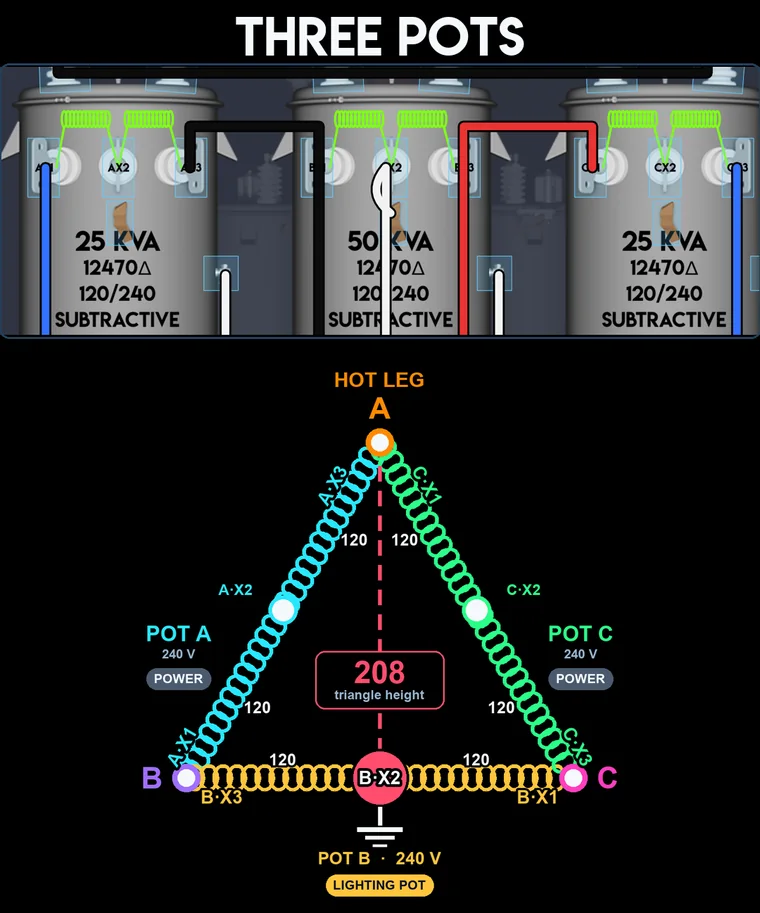
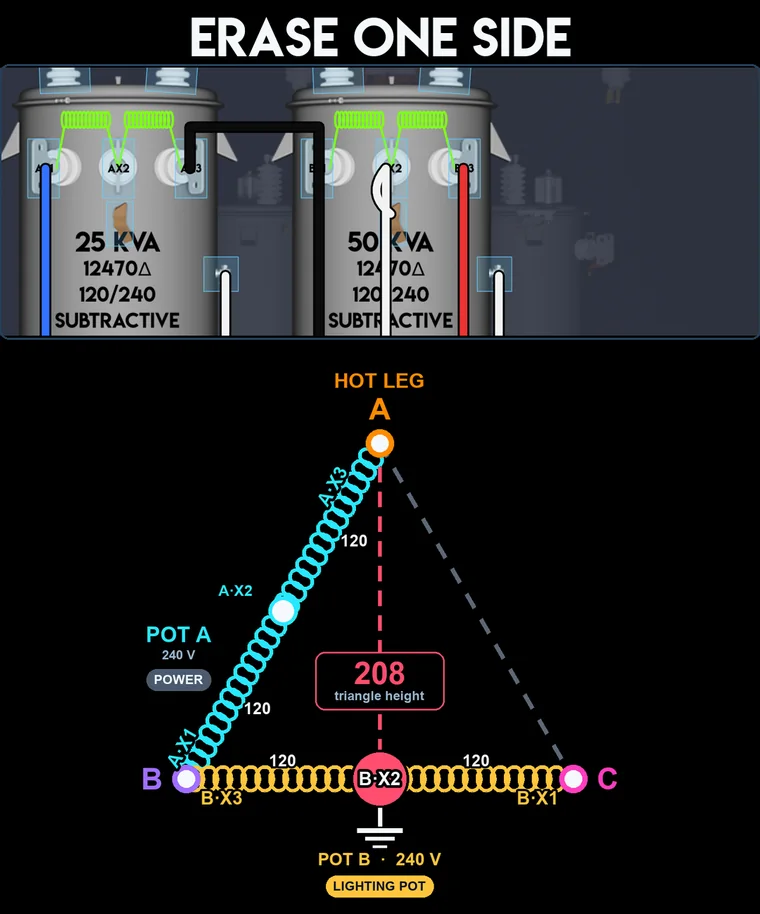
Everything else is just the same delta secondary we already know and love: 120 volts phase to ground on the coils with the ground reference, and 208 on the opposite corner. Move the ground reference, move the wild leg.
What does an open bank cost you?
Versus a closed bank, open banks just aren't as good, and here's the simple reason: you can't get as much three-phase out of the same transformers.
The pots are every bit as efficient as they always were. Efficiency doesn't change. It's a kVA capacity issue: you can't use everything you paid for on an open bank, so the pots have to run bigger to make up for it.
The breakdown and the numbers behind all of this are coming soon in another video.
Why one pot is almost always bigger
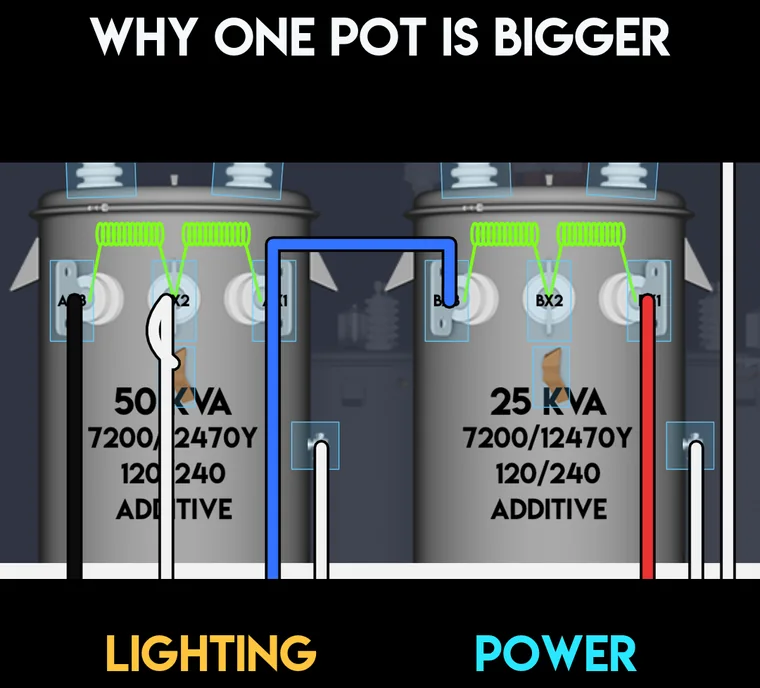
We already know the lighting pot carries all of the single-phase load. But on an open bank, the lighting pot also carries two thirds of the three-phase load.
So it's almost always going to be a bigger pot than the power pot, which carries nothing but one third of the three-phase load. That's the one big can and one little can you see on these poles.
You can never make three-phase out of single-phase
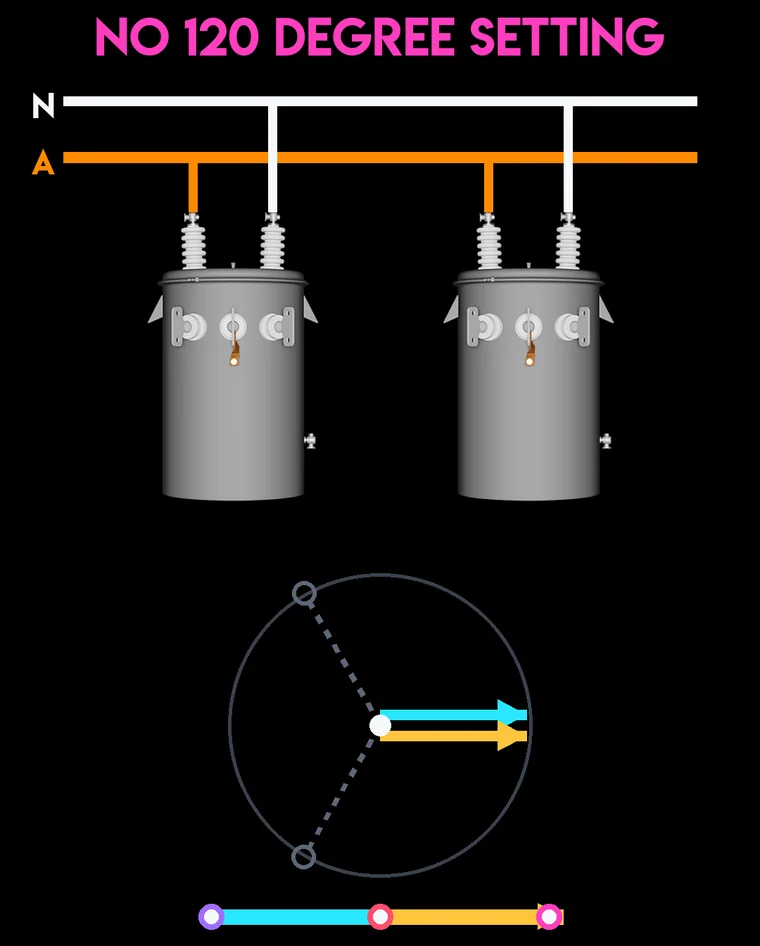
To button this up: you can never make a three-phase secondary out of a single-phase primary.
A transformer secondary only comes out in phase with its primary, or 180 degrees out. There is no 120-degree setting on a transformer, or anything like that.
So take two pots off the same phase, and their secondaries end up 0 or 180 degrees apart from each other. The vector goes flat, and that's just a single-phase service.
✅ The short version
- Two ways to build a normal open bank. Open wye / open delta: two primary phases plus the neutral, and the one you'll see most. Open delta / open delta: all three primary phases, and much rarer, because with three phases present the reason to go open disappears.
- Both work the same way: the two primaries sit 120 degrees apart, each pot copies its own primary's angle onto its secondary, and the open side reads a full 240 even with no core behind it.
- An open bank is always a delta secondary. Erase one side of the triangle and all three corners survive, so all three phases survive. The wild leg still reads 208 to the ground reference.
- The cost is capacity, not efficiency. You can't use everything you paid for, so open bank pots run bigger.
- The lighting pot carries all the single-phase plus two thirds of the three-phase, which is why one can is almost always bigger.
- No transformer makes three-phase from a single-phase primary. In phase or 180 out are the only options, so the vector goes flat.
▶ Build it and break it.
You just read the why. You can wire up both open banks yourself in XFMR Lab, the open wye / open delta and the open delta / open delta, then meter the secondary and watch two pots hand you full three-phase in real time. Build it, break it, and see the voltages come to life.

XFMR Lab is $19.99, one time. All lessons, 16 labs, the Sandbox, and Death Traps included. No subscription.