The system neutral: why everything up there bonds to it
Put a clamp on a healthy pole ground and you can read amps. Nothing is broken and nothing is leaking. That current is the system doing its job, and once you know why, the whole neutral-versus-ground debate sorts itself out. This is Part 1 of the How & Why series on the system neutral.
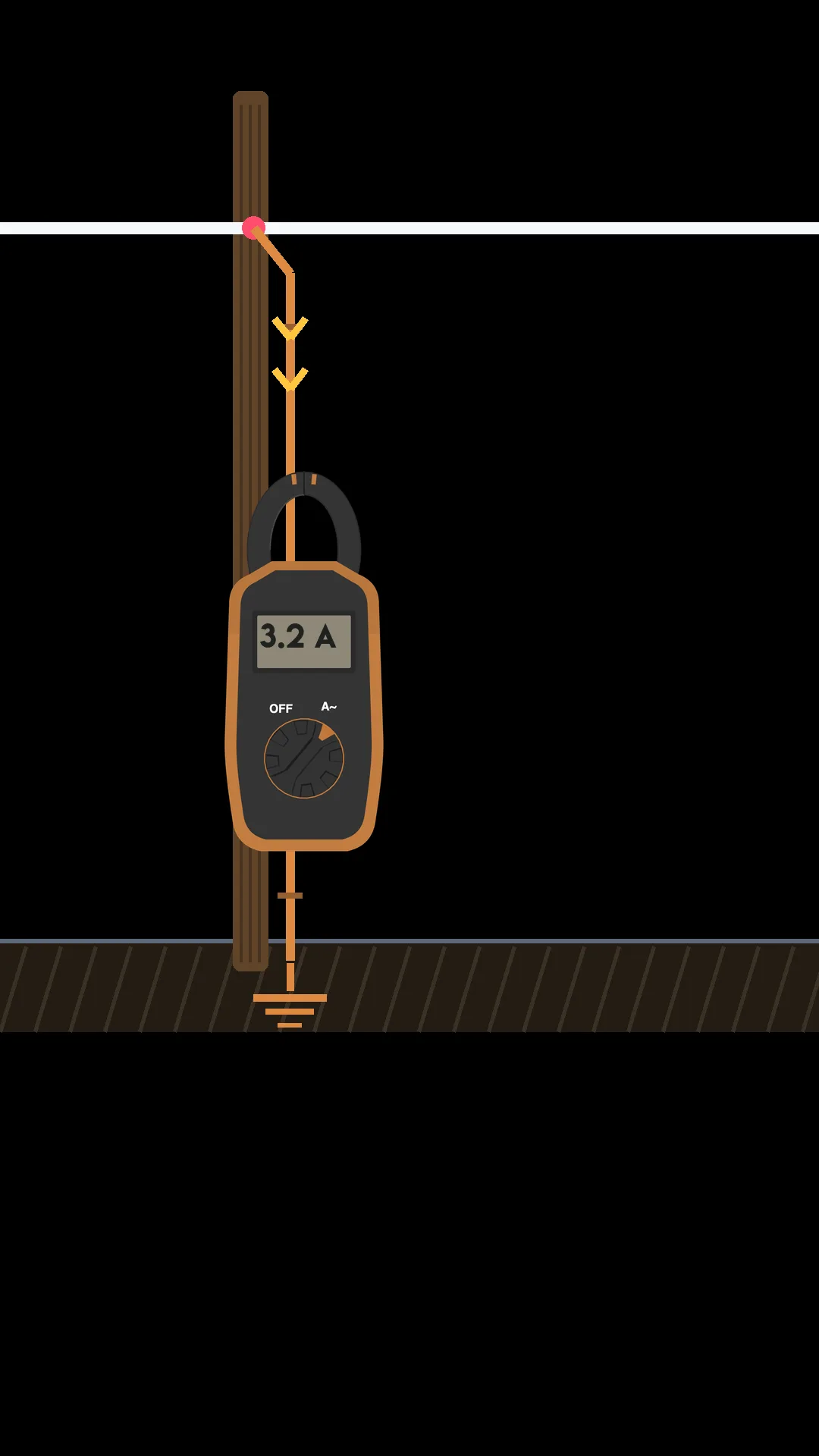
The full breakdown. More on the channel ↗
At the house it's a debate. Up the pole it isn't.
At a house, neutral and ground are two different wires with two different jobs. The neutral works for a living, carrying load current back every second the lights are on. The ground wire dead-ends at a rod and waits its whole life for a fault.
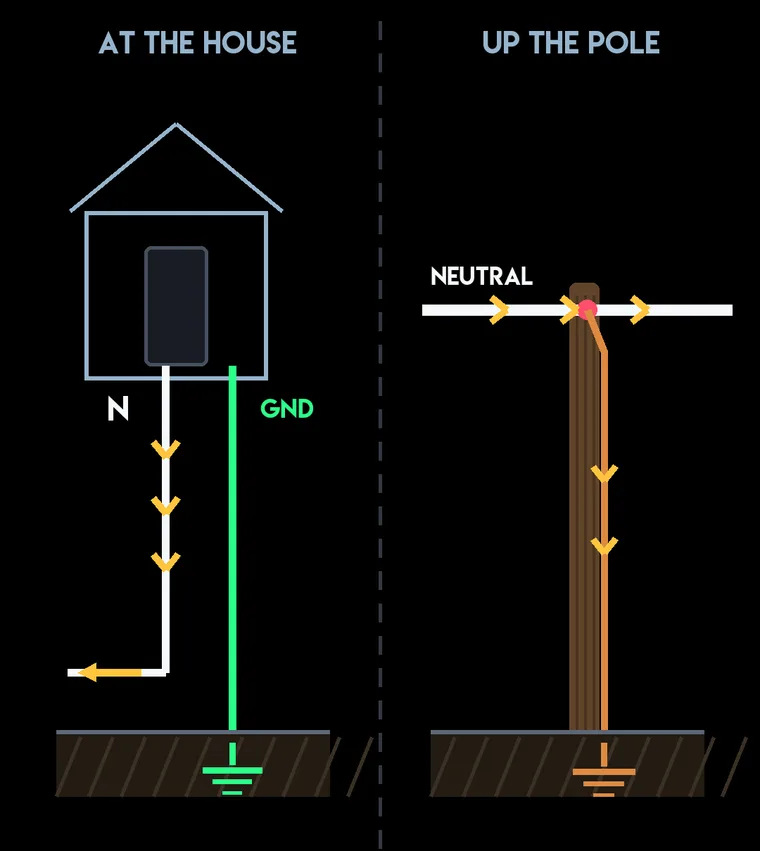
At the top of the pole, that debate doesn't really exist. The neutral IS the ground. It's tied to earth at every pot and at least four times a mile by code, and on most systems, at every single pole. And everything on the pole bonds to it: equipment grounds, arresters, all of it. One big web, connected to dirt over and over again.
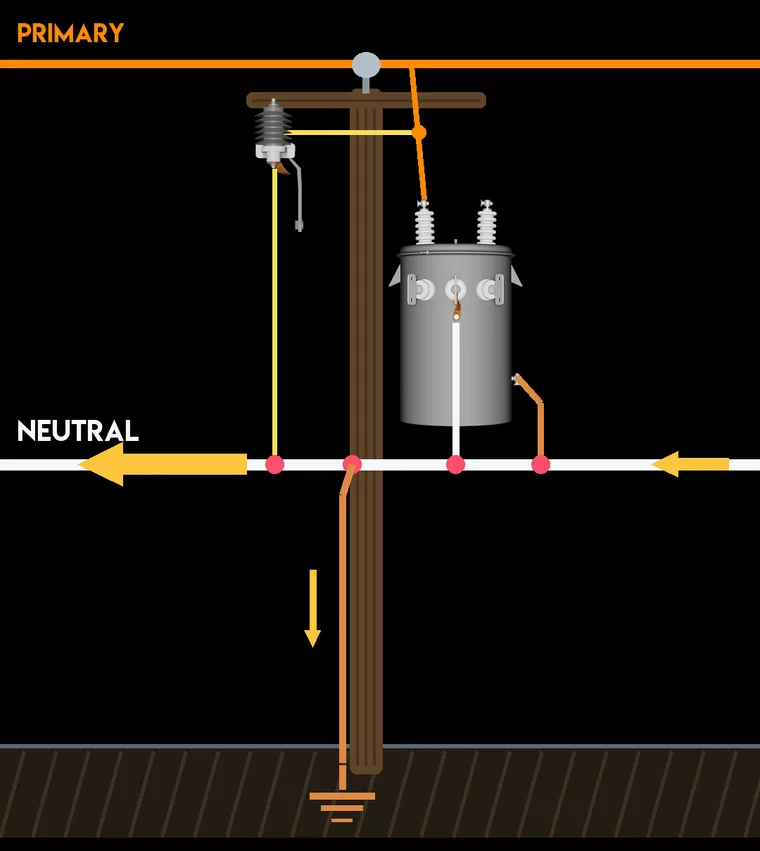
Why are there measurable amps on grounds?
Current doesn't take the path of least resistance. That's a myth. It takes every path available, split by impedance.
Most of the return current rides the neutral home, but part of it is always finding its way back through whatever path it can, including the dirt under your boots. The more the neutral or its connections degrade, the more current takes those alternate routes.
So amperage on a pole ground can be normal. It should also be minimal. One ground reading far more than its neighbors means the neutral above it is hurt and the earth is picking up the slack.
Why the neutral only carries the unbalance
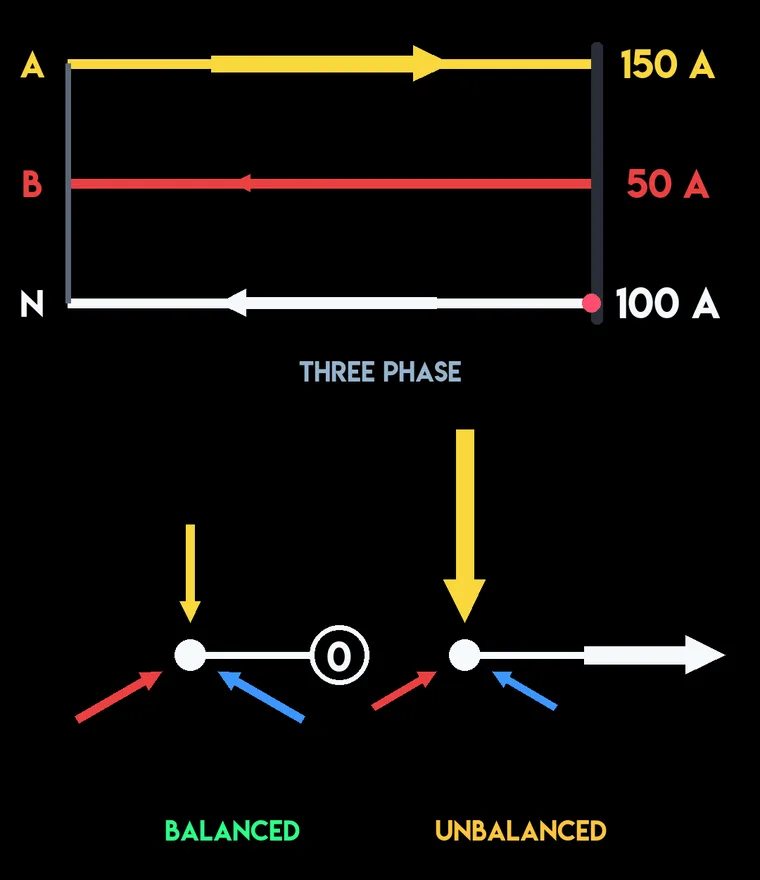
Everything on the neutral is pulling or pushing against something else. At your house, your two 120-volt legs push through the neutral in opposite directions, so it only carries whatever doesn't cancel between them. One leg at 150 amps and the other at 50 leaves exactly 100 on the neutral.
Same thing on the feeder. Three phases, 120 degrees apart: equal loads cancel each other out to zero. The neutral is quietest when the system is balanced, and every light that flips on, every lopsided tap up and down the line, lands on it.
1926: when everything had its own ground
So why does everything up there share one ground and interconnect? Fun fact: we tried it the other way first, and it went badly.
Back in the 1920s, a pot's lightning arrester had its own individual ground rod, and the secondary neutral was grounded separately. When lightning slammed tens of thousands of amps into that one rod, the whole primary side of the pot jumped way above the secondary for a split second, and that difference landed across the insulation between the windings. Pots were failing to lightning all over.
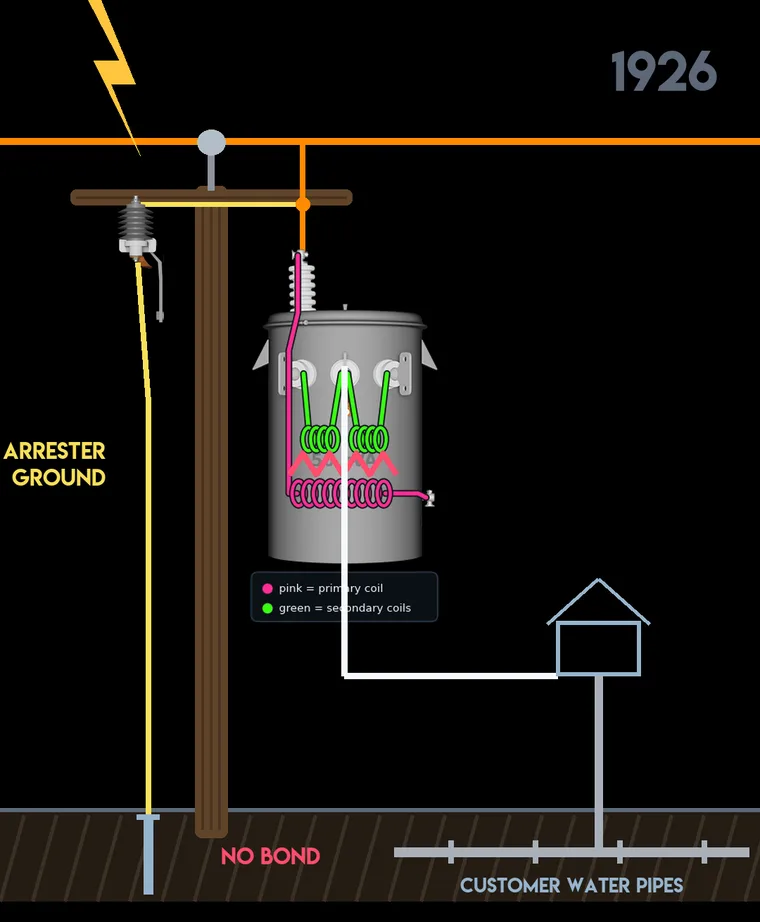
In 1932, Purdue and the Chicago utilities proved that bonding the arrester ground to the secondary neutral cut that surge voltage by up to half (Harding & Sprague, AIEE Transactions, 1932). Two reasons:
- Bonded, the whole pot rides the surge as one piece, so the insulation never sees the difference.
- The secondary neutral was the best ground on the pole. It tied into almost every customer's water piping, miles of buried metal, while the arrester had one lousy rod.
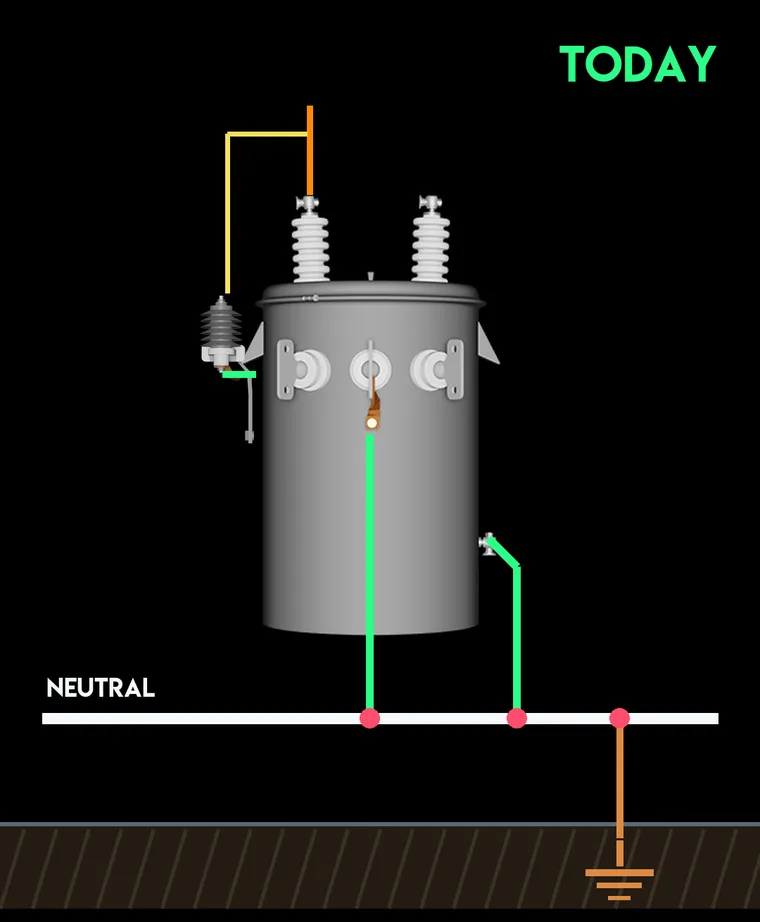
That's why, to this day, your arrester's ground connects to the tank, the tank connects to the X2 neutral, and everything's connected.
The part that bites: parallel vs series
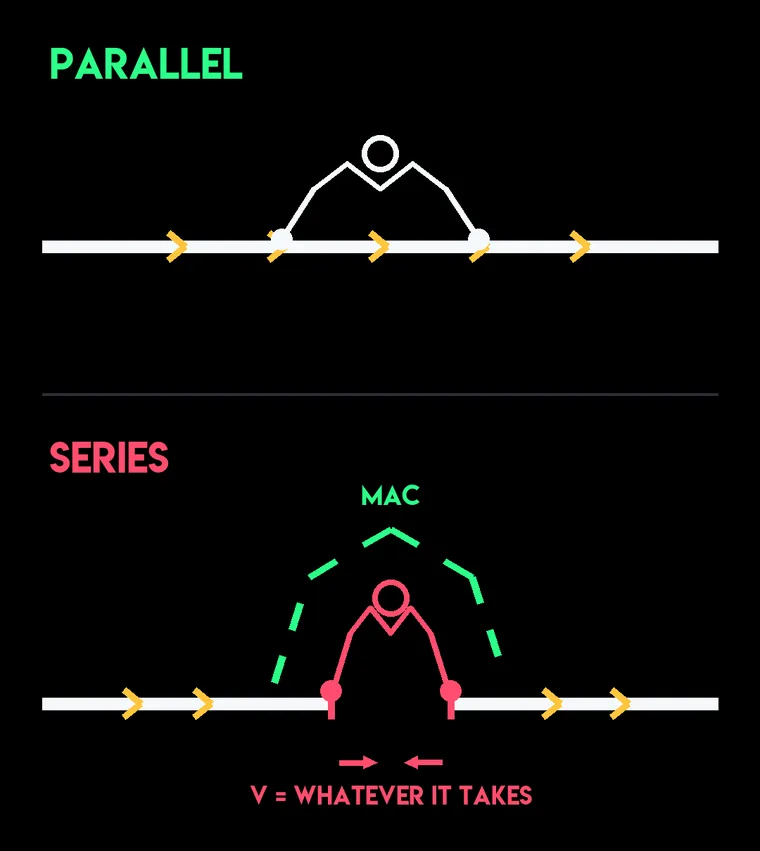
All that bonding is why an intact neutral is safe to touch: grab it and you're in parallel with miles of ground references. Your body against milliohms of copper takes essentially nothing.
But cut it under load and you put yourself in series. The current does not stop. The voltage across that opening climbs to whatever it takes to keep pushing current through the dirt. A couple hundred volts on a good day. Toward primary voltage on a bad one. And up the line, the neutral is carrying every customer's unbalance at once.
✅ The short version
- At the house, neutral and ground are two wires with two jobs. Up the pole, the neutral IS the ground: earthed at every pot, at least four times a mile by code, usually every pole.
- Current takes every path, split by impedance. Amps on a healthy pole ground are normal, and should be minimal.
- The neutral carries only what doesn't cancel: the difference between your two legs at the house, the vector sum of the three phases on the feeder.
- Everything bonds together because of lightning. The 1932 Harding & Sprague study showed bonding the arrester ground to the secondary neutral cut surge stress across the windings by up to half.
- Touching an intact neutral is parallel. Cutting one is series, and the voltage across the open climbs to whatever it takes. Mac-out first. Treat a broken neutral like it's hot.
▶ Build it and break it.
You just read the why. In XFMR Lab you can wire the bank yourself, ground it right or ground it wrong, and meter what happens, including the Death Traps that show you exactly how a floating tank or a backfed line bites. Build it, break it, and see the voltages come to life.

XFMR Lab is $19.99, one time. All lessons, 16 labs, the Sandbox, and Death Traps included. No subscription.