The square root of three: every weird voltage is the same number
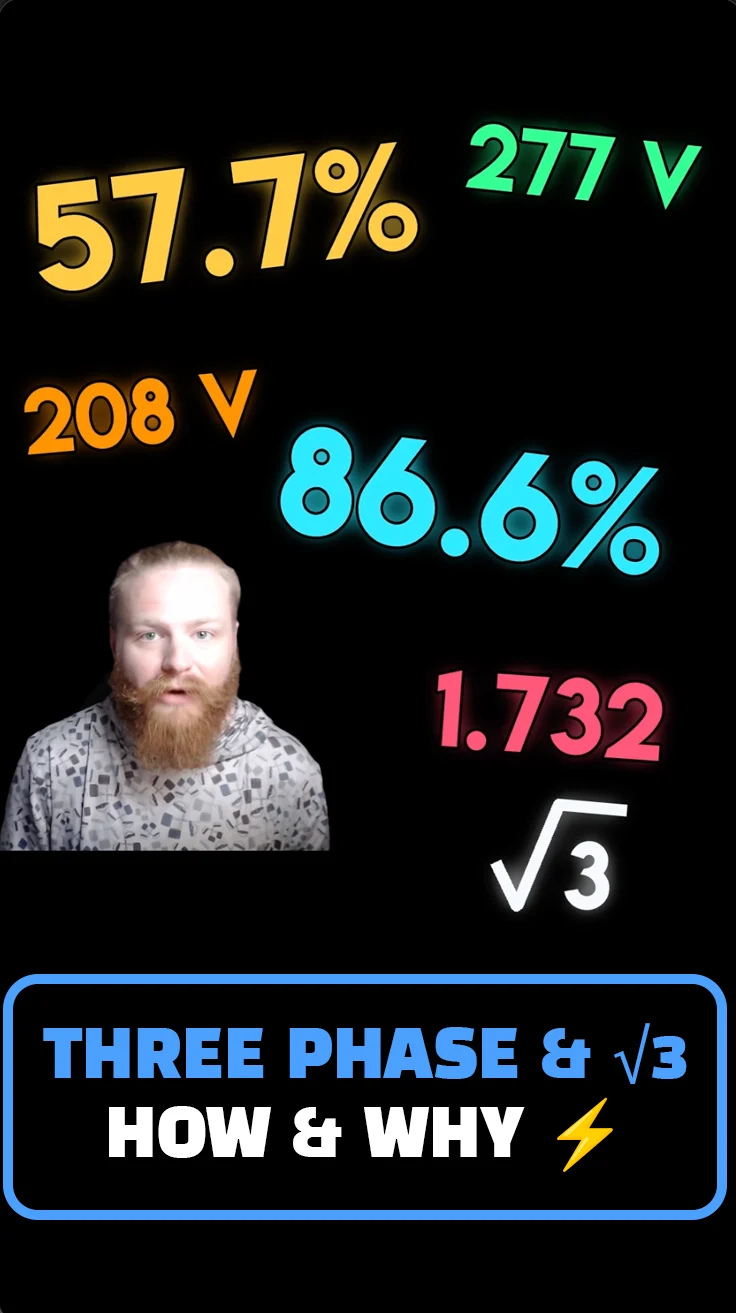
57.7 or 86.6? The comments fought about it for a week, and both camps were right. Every number in that fight, and the wild leg's 208, and the 12470 over a 7200 coil, comes from one number: 1.732, the square root of three. Here's where it comes from, with nothing fancier than the Pythagorean theorem.
The full breakdown. More on the channel ↗
A triangle or a Y
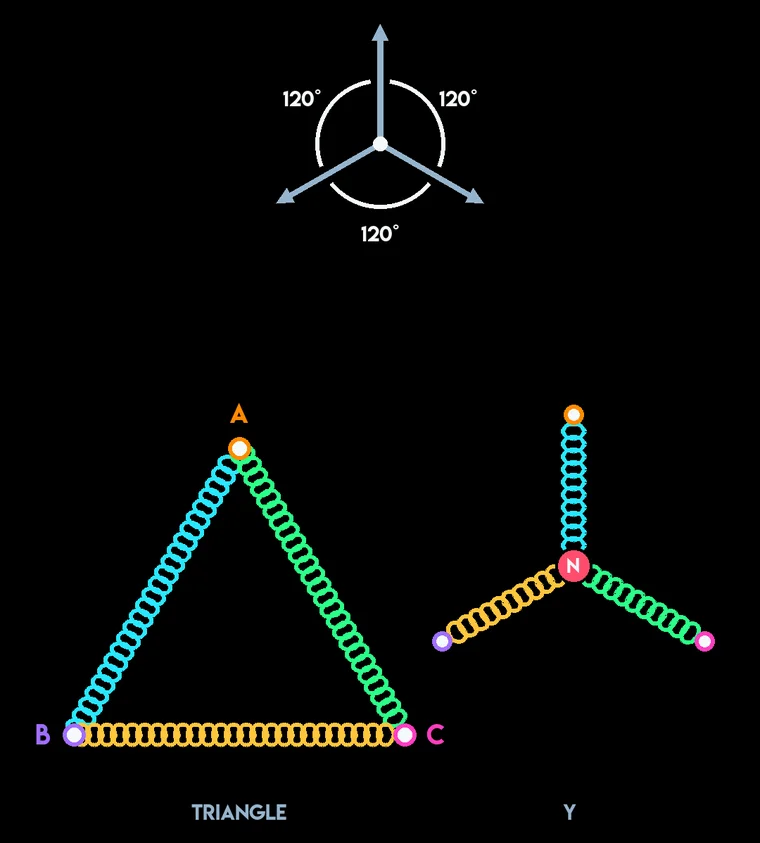
Three phase is three voltages, 120 degrees apart. Put that on paper and you get one of two pictures: a triangle (the delta) or a Y (the wye). Every voltage reading you'll ever take on that system is just a distance between two points on one of those pictures.
Corner to corner across one coil of a 240 delta: 240. And as the wild-leg video showed, the wild leg is the delta's height measured from the grounded X2 up to the far corner: 208.
The wye: coil to tip-to-tip
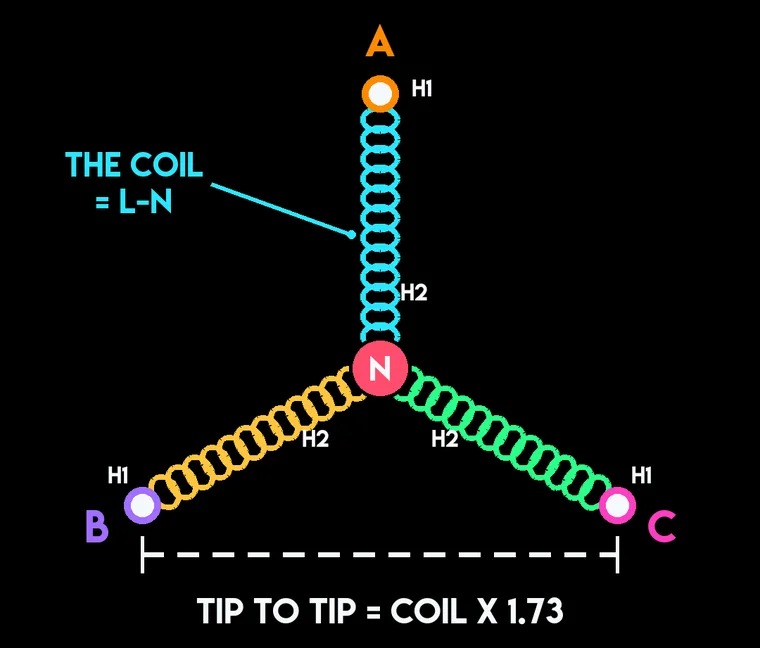
On a wye, every coil is a transformer winding that starts on its own phase (H1) and lands on the neutral in the center (H2). Your phase-to-phase voltage runs from tip to tip, and that distance always comes out to the square root of three times the coil.
Why 1.73? Split the triangle.
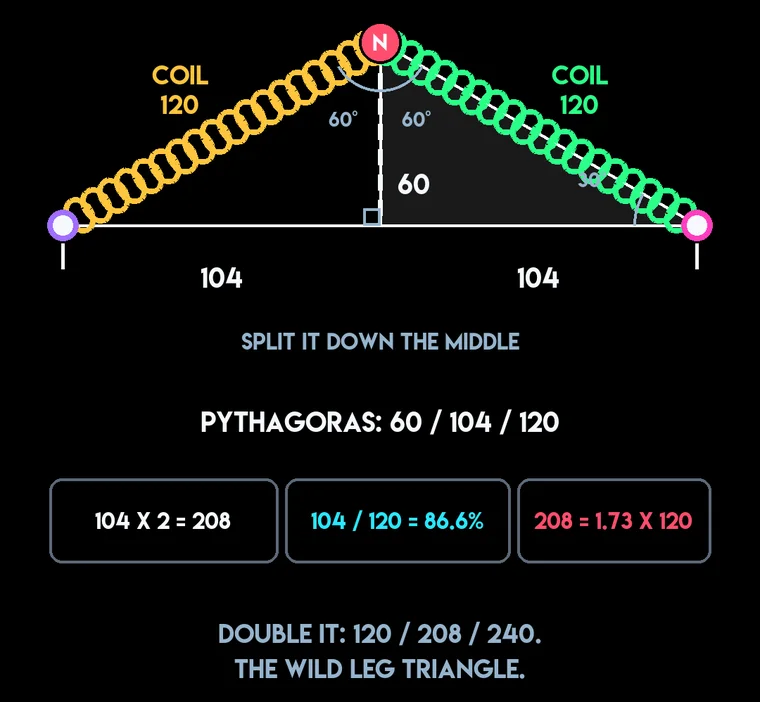
Two coils, 120 degrees apart, make a fat-bottomed triangle. Split it straight down the middle and you get two matching right triangles. Take one:
- The coil is the long side: 120 volts.
- The centerline is half a coil: 60 volts.
- Pythagorean theorem the third side: √(120² − 60²) = 104.
That 104 is half the phase-to-phase reading. Double it: 208. Same answer as 120 × 1.73. And 104 out of 120 is 86.6%. Sound familiar? Hold that thought.
Every 1.73 you will ever use is just a triangle getting cut in half somewhere. So yes: the Pythagoras crowd in the wild-leg comments was right all along.
Why 120/208 and 277/480 look backwards
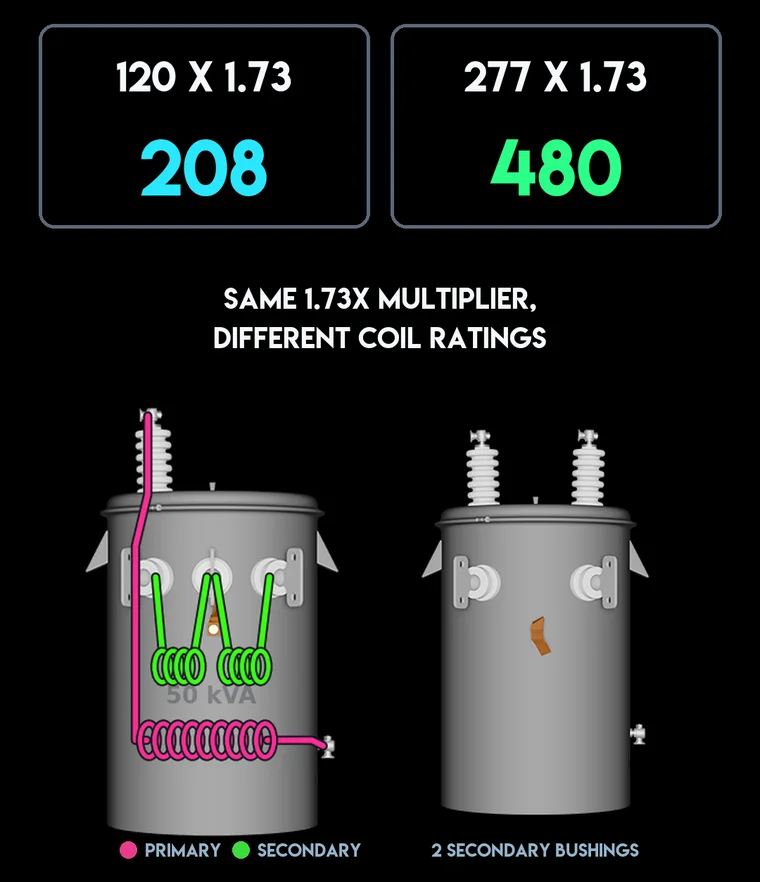
120/208 looks like the phase-to-phase caught the square root of three. 277/480 looks like the phase-to-ground caught it. Nothing moved. The coil is built to a specific phase-to-ground voltage, and it's the same 1.73 multiplier both times:
- 120-volt coils → 120 × 1.73 = 208 phase to phase.
- 277-volt coils → 277 × 1.73 = 480 phase to phase.
The only thing that changes is which number the system gets named by. Your pot does the same thing up top: a 7200 coil on a 12470Y system is that same 1.73, right on the nameplate. On most two-bushing secondary pots, the nameplate just reads the phase-to-ground.
The open bank: 75 to 43.3, not 50
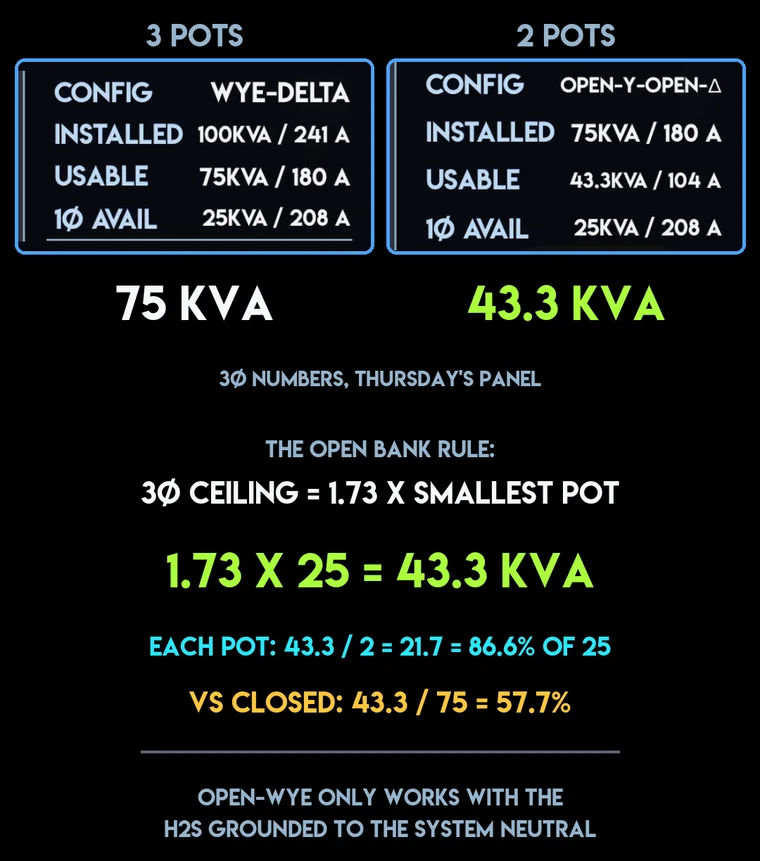
Thursday's Knowledge Check: a closed wye-delta (a 50 and two 25s) loses a 25 kVA power pot. And yes, for open wye the H2s have to be grounded to the system neutral or none of this works. The bank's three-phase capacity drops from 75 kVA to 43.3. Not 50. Here's the why, from the rule down:
- The open bank rule: your three-phase ceiling is 1.73 × the smallest pot. There it is again. 1.73 × 25 = 43.3 kVA.
- Per pot: split 43.3 across the two pots still working: 21.7 apiece. And 21.7 out of a 25 kVA pot is 86.6%. The same 0.866 from the triangle.
- For the bank: compare what you kept to what you had. 43.3 out of 75 is 57.7%. Square root of three, wearing its third hat.
The leftover 25 (the beat the video ran out of time for)
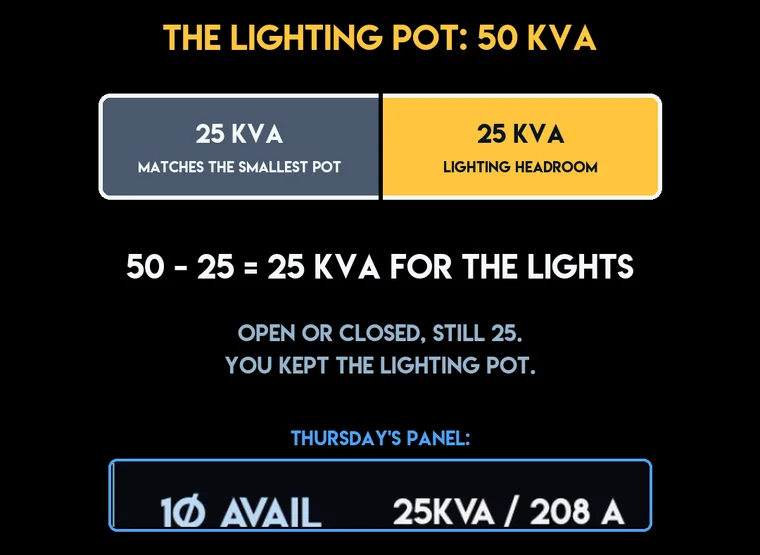
The Knowledge Check panel showed 25 kVA of single-phase still available, before and after losing the pot. That's not a coincidence, it's simple math: the lighting pot only owes the bank what the smallest power pot can match. A 50 kVA lighting pot committing 25 to three-phase work keeps 50 − 25 = 25 kVA for the lights. Lose a power pot and that number doesn't move, because the pot you lost wasn't the lighting pot.
One number, three hats
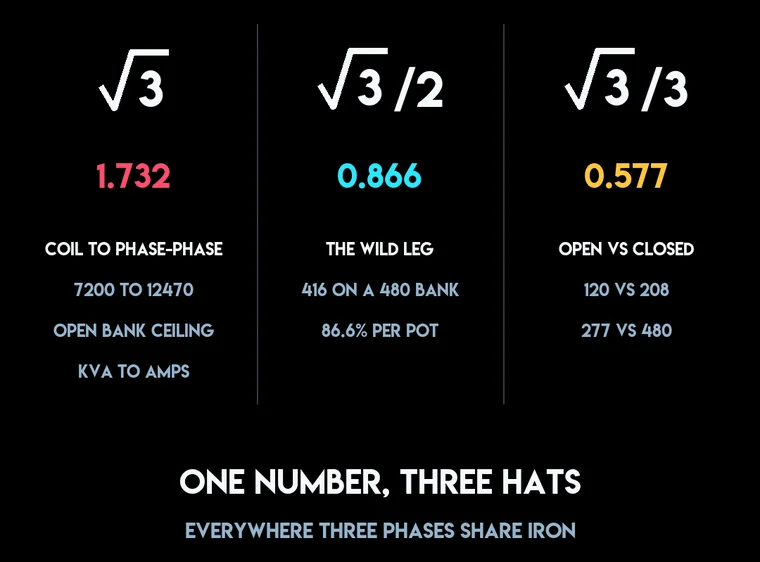
So where does 1.73 live? Phase-to-ground to phase-to-phase on every wye system: 7200 to 12470, 14.4 to 25 kV. The 208 wild leg on a 240 delta and the 416 wild leg on a 480. Wye secondary phase-to-phase. Open and closed bank capacity. Even the amps column on the capacity panel: turning kVA into amps on three-phase runs through 1.73 too (43.3 kVA at 240 V is 104 A). Anywhere three phases share iron, evenly spaced from each other, root three is in the math.
✅ The short version
- Three phase drawn on paper is a triangle or a Y, and every reading is a distance between two points on that picture.
- Split two 120°-apart coils down the middle and Pythagoras gives you 60 / 104 / 120. Half-span 104, doubled = 208 = 1.73 × the coil. That's where √3 is born.
- The coil is built to a phase-to-ground voltage. 120 × 1.73 = 208, 277 × 1.73 = 480, 7200 × 1.73 = 12470. Same multiplier, different name tags.
- Open bank ceiling = 1.73 × the smallest pot. That single rule produces Thursday's 43.3, the 86.6% per pot, and the 57.7% versus closed.
- √3 = 1.732, √3/2 = 0.866, √3/3 = 0.577: one number, three hats, everywhere three phases share iron.
▶ Build it and break it.
You just read the why. In XFMR Lab you can build the closed bank, pull a pot, and watch the capacity panel land on 43.3 yourself, then meter the wild leg, the corner ground, and every voltage in this write-up. Build it, break it, and see the numbers come to life.

XFMR Lab is $19.99, one time. All lessons, 16 labs, the Sandbox, and Death Traps included. No subscription.